Reb Michoel
SchnitzlerReb Michoel Schnitzler
the
Song
of a
Lifethe Song
of a Life


B"H
To our dear friends, supporters of Tzedaka and Chessed, who stand by and support our institutions:
R' Beri Weiss shlit"a
and his esteemed wife, Mrs. Raizy shetichyeh,
When I saw the strong and deep connection that Mrs. Raizy had with her father, the well-known and unforgettable Rabbi Michael Schnitzler z"l, I began to think about it more deeply. I wanted to understand where such a powerful bond comes from. What creates such a lasting connection between a daughter and her father.
After looking into it, the answer became clear. Rabbi Michael was a person full of ahavas habriyos: deep love for others—and certainly for his own family. It is not surprising that he would call his daughter often, even when she was busy, just to tell her: "You don't have to call me back, I just wanted to say that I love you."
As Chazal teach, "k'mayim panim el panim"—the way one heart relates to another is reflected back. The strong love and connection she feels toward her father is natural and enduring. It is a bond that cannot be broken, even after his petirah. As the pasuk says, "mayim rabbim lo yuchlu lechabos es ha'ahavah", true love cannot be extinguished.
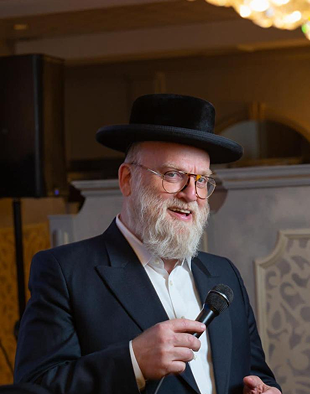
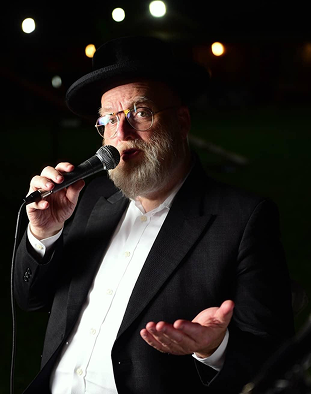
I thought it would be meaningful to express this connection through a portrait of Rabbi Michael, because sometimes a look can say everything.
"K'mayim panim el panim" also teaches that just as a reflection shows what is in front of it, so too maaseh avos siman labanim. We clearly see how Rabbi Michael's derech: his Chessed, his Simcha, and his warm, welcoming presence, all continue through his daughter and her husband, who are carrying on in his path.
Rabbi Michael's song did not stop. He lived the pasuk "Ashirah LaHashem b'chayai" in a real way. As is often said, a person's life itself, when lived properly, is a form of shira to HaKadosh Baruch Hu. In his case, his whole life was one continuous expression of Shira v'shevach, Hallel v'zimra - not only in music, but in everything he did.
And when the time came, the Ribbono Shel Olam took his pure neshamah under the Kiseh HaKavod. As the Rebbe R' Bunim of Peshischa taught, Hashem values even the "shirayim"—the parts of the song that were left unfinished. What Rabbi Michael did not complete in his lifetime continues through his children and future generations, until the time of techiyas hameisim.
With appreciation for a special, great man, and for those who continue in his path,
On behalf of "Pnei Menachem institutes"
Nachman Y. Widislavski

Reb Michoel Schnitzler
the Song of a Life
Who Wants Life
"מי האיש החפץ חיים... – Who is the man who desires life, who loves days to see goodness?"
We knew such a man – all of Klal Yisrael did.
Reb Michoel Schnitzler. A man who seemed to live entirely inside those words. A man of deep feeling, of genuine simchah, blessed with a voice of rare richness, and an even rarer understanding of what that voice was meant to be used for. He lived the words "כבד את ה' מהונך" truest to the most literal peirushim, bringing kavod to Hashem not only through what he gave materially, but through the gift of his golden voice, which carried so much more than melody.
Reb Michoel Schnitzler z"l.
There is hardly anyone who has not heard of him.
"בכל הארץ יצא קום ובקצה תבל מיליהם – Their line goes forth throughout the earth, and their words are at the end of the world…"
His songs traveled far, carried across continents, reaching hearts that had never seen him but instantly felt like they knew him. There was something in the way he sang, something about the words he chose and the way he wove them together, that made his music feel personal. It wasn't only the richness of his voice, or the rare combination of depth and warmth; it was the feeling that the song was coming from somewhere real and deep – and was likewise meant to reach somewhere real and deep inside the listener.
Running through everything he created was a powerful thread: a deep belief in every single Yid, whoever and wherever he might be, and his innate longing to connect with Hashem. This was his "line" that "went forth throughout the land," his message that spread further than any one person could have imagined. It echoed in homes, in cars, in moments of joy and in moments of struggle. It lifted people, comforted them, gave them courage, and, for many, opened a door back toward something they hadn't even realized they were missing.
A Heart That Saw Good
Setting out to understand "mi ha'ish," who this incredible man was, the words of the passuk begin to take on a deeper meaning.
He was a man who truly desired life, not in a superficial sense, but with a kind of leibedikkeit that filled every moment. There was a vitality to him that was impossible to miss, a sense that he was fully present, fully alive, wherever he was. And "ohev yamim," oh, he loved his days. He filled them with an overflowing ahavas Yisrael that extended to everyone, without distinction, and ahavas Hashem, fierce love of his Creator. For him, the two were inextricably linked. He loved Hashem deeply, and therefore he loved His creations. It was that simple, that natural.
His love was not something that depended on externals, or influenced by the way a person looked or where he came from or which group he belonged to. He was able to "see good", to look at another Yid and recognize the neshamah within him, that G-dly spark that remains forever untouched and pure.
"Michoel b'achas…"
Asking those who knew him to describe him, one word comes up again and again: Chiyus. It was there in everything he did. In his singing, in his davening, in his learning, in the way he celebrated every mitzvah, and in the way he did a favor for a fellow Yid. And that is why it is so difficult, even now, to come to terms with the fact that this man, so full of life, is no longer with us; that a presence so full of energy, warmth, and goodness could suddenly be taken from our midst. The ache does not fade with time; if anything, it's deepened. Because what he gave was not something that could easily be replaced. His passing left behind a void that continues to grow.
Reb Michoel, who will lift, who will heal, who will bring back that warmth you gave so freely?!
The Power of One
Chazal teach (Makkos 24a): "Chavakuk …established them (the 613 mitzvos) upon one, as it says (Chavakuk 2:4): 'וצדיק באמונתו יחיה – and the righteous person shall live by his faith.'" [1]
Tzaddikim add: "Do not read this as 'shall live' but rather as 'shall revive'", because the tzaddik revives others with his emunah.
The Gemara (Brachos 4b) says: "Michoel – be'achas, in one." And yes, Reb Michoel grasped that "one" – the core that Chavakuk distilled everything to: emunah. His was a relationship with Hashem that was constant and real, that shaped the way he saw the world – and spread to so many people in ever-widening circles.
True, Chazal say that with time, the deceased are gradually forgotten from the heart, but what about someone whose impact remains alive? Whose influence became woven into the lives of others and continues to echo in thousands of Jewish homes even now? Reb Michoel has not been forgotten. His chiyus continues to pulse, even now, within the hearts of all those he touched.
Turning Pain into Growth
His life was not without hardship.[2]
Looking at him and the joy he radiated, one could be forgiven for imagining that Reb Michoel's life had always been smooth, that he had been spared the kinds of struggles that weigh a person down. But nothing could be further from the truth. Reb Michoel was born to parents who had endured the horrors of the Holocaust, carrying with them wounds that never fully healed. His mother lived through the horrific experience, among others, of having to clean the room of the infamous Dr. Mengele every night. Like so many children of survivors, the traumatic past seared itself into the young, fragile home. Then, at the age of fifteen, Reb Michoel lost his father.
He knew what it meant to feel loss, to live through the raw void that reshapes a young person's world. And yet, from within that pain, something remarkable grew. There is an idea that hardship can expand a person's heart, based on the passuk "צרות לבבי הרחיבו" – homiletically translated as "the troubles expanded my heart." Reb Michoel lived that. The difficulties he faced did not close him off. They opened him, gave him a sensitivity to others that could not be taught in any other way, an ability to sense another person's hidden struggle which no one else saw.
He became someone who could not ignore pain, especially the pain of orphans or those who felt alone or broken. Even when he himself was physically weak, hospitalized after serious heart attacks, when he had every reason to rest and focus inward, he continued to look outward. He would go from bed to bed, searching for someone who could use a good word. Because that was who he was: always thinking of others before himself, if at all.
Lev Tov
When Rabi Elazar points to a "lev tov" as the single "good path which a person must adhere to" (Avos 2:10), Rabi Yochanan responds: "I prefer the words of Elazar the son of Arach to yours, for his words include all of yours."
Explaining what a "lev tov" actually means, the Tiferes Yisrael writes: "Lev tov, a good heart – his heart is always happy and ready to bring goodness upon everyone." A perfect reflection of Reb Michoel, if there ever was one.
With Them in Their Pain
It would be inaccurate to say that the hardships he endured left no mark on him. On the contrary – they shaped him, and in the most remarkable way. The struggles he faced became the very ladder through which he rose.
"והנה סלם מוצב ארצה וראשו מגיע השמימה, והנה מלאכי (אותיות "מיכאל") [4] אלוקים עולים ויורדים בו... – And behold! a ladder set up on the ground and its top reaches to heaven; and behold, angels of G-d are ascending and descending upon it…"
His struggles became rungs, lifting him to great heights of simchah and song, while at the same time giving him the rare ability to descend into another person's world, to feel their pain from within, and to gently lift them out of it. Because he knew pain, he could recognize it. Because he himself felt it, he could meet it unflinchingly.
Chazal speak of Hashem's Presence in the pain of His people: "עמו אנוכי בצרה – I am with him [Am Yisrael] in his suffering, "בכל צרתם לו צר" – their pain becomes His pain as well.
And this is what the Midrash (Shemos Raba, Bo) says:
"'An angel of Hashem appeared to him in a flame of fire from within the thorn bush…' Said Hashem to Moshe: Don't you feel that I am in pain, just as Yisrael are in pain? Know that from the place from which I am speaking to you, from inside the thornbush, I share, kiveyachol, in their suffering…"[5]
The Midrash continues:
"'An angel of Hashem appeared…' – Rabi Yochanan said that this is Michoel… Rabi Yosi "ha'aroch[6]", wherever they would see him, they would say the name of Rabeinu Hakadosh. So too wherever Michoel is seen, that is where the kavod of the Shechinah is."
Reb Michoel was, to so many people, that angel who stood at their side as they suffered in the thornbush. He was with them completely, giving them the feeling that "I am with you in your suffering". And that very sense and the knowledge that they were no longer alone, itself paved the way to healing.
He knew not only how to sing, and talk – but to listen. To really and truly listen. His entire being participated in the mission of making the person before him feel seen and heard. His heart was open. His spirit was completely ready to feel and embrace the pain. His mouth and tongue were ready to find just the right word. His eyes radiated kindness and accepted. His shoulder was always available for another person to cry or lean on, his hands and feet ever ready to do whatever was needed to make the other person's burden lighter.
מיכא"ל – כל איבריו יחד מוכנים לעזור
A "Reb Michoel" be'etzem.
Michoel at Their Side
Like a true malach, Reb Michoel gave living expression to the words of the passuk "In all their suffering, he suffered… and the angel of His Presence saved them." He stood at the side of those who were struggling, those who felt judged, broken, or alone, and always, always, without fanfare. Just like in the famous words he sang, "Miyemini Michoel shteit a malach…"
To him, these weren't just words he sang; it was who he, Michoel, was. "Hu – haya omer." What he lived was what he gave over. Be that other person's malach.
"And wherever Michoel is seen, that is where the kavod of the Shechinah is."
It was he, and his music, that paved the way for so many Yidden to discover the Shechinah and find their way back. His reach went so far, too. Yidden in the most distant places, across countries and continents, found their lives were changed through a moment of emes they faced through his songs. Like that man from Argentina who returned to Shabbos observance because of Reb Michoel, without ever having met him, only through hearing his pure singing. And he was far from the only one.
Simply a Messenger
Chazal (Bamidbar Raba 61) tell us that there is nothing more precious before Hashem than a shaliach who is sent to fulfill a mitzvah and gives of himself completely to succeed in that mission. The Chiddushei HaRim teaches that every Yid is that kind of "messenger", sent into this world with a mission to fulfill.
Reb Michoel lived with that awareness. All his life, he saw himself as a shaliach tzibbur, a messenger sent to bring simchah to others, to give voice to the song of the neshamah, and to draw Yidden closer to their Creator. His unique avodah of song, so entirely his own, was never just a talent; it was fully and completely his life's mission. He used the gift he was given in the Heichal Haneginah, so close to Heichal Hateshuvah, to weave messages that would uplift and stir buried longing, that would brush the dust off the tiny pintele Yid inside every person.
His songs always gave listeners a powerful feeling of kirvas Elokim. They opened hearts that had long been closed, hearts that were searching, often without even knowing for what.
Often with mesirus nefesh, he served Hashem through "עבודת הקודש עליהם בכתף ישאו – the work involving the holy, which they were to carry on their shoulders," which Chazal (Erchin 11a) explain "yisa'u, carry – meaning song."
He was unyielding in his avodah, resolute even in the face of criticism, voices that questioned his reaching out, his willingness to extend a hand to those on the margins. He simply did not allow himself to be pulled into that noise. Certain of his purpose and mission, he continued forward and kept on singing.
A Shabbosdik Heart
There is a beautiful idea brought in the name of the Chidushei HaRim, who heard it from the Ohev Yisrael of Apta at the "Ostilla wedding", about the words we say on Shabbos, "ויום השביעי משבח ואומר – and the seventh day praises and says…" And that is, that the Shabbos itself gives praise, "Mizmor shir leyom haShabbos!" And because the Shabbos sings this praise, it awakens the song in everyone else as well, and now they too are able to sing and praise Hashem.
When the Chidushei HaRim shared this vort, he added that he felt its delicious sweetness for a year and a half!
Ah. Reb Michoel was a "Shabbos Yid." He lived his life from one Shabbos to the next. He lived it, felt it and brought it with him wherever he went. It is no wonder that the Shabbos gave him the uncanny ability to awaken other people's hearts too. He would sing about Shabbos, about its kedushah, about its warmth – and people would feel it. They would begin to experience Shabbos differently after that.
Always Running [7]
Every Friday night, the scene would repeat itself. Reb Michoel would gather guests from whoever he could find them. His guests were from every kind of background, but he had a special place in his heart for those who had nowhere else to go. The lonely, the forgotten, the brokenhearted, the mentally unwell — people others might pass by without a second thought — were the honored guests at his Shabbos table.
He would wait for them before making Kiddush, and if another guest would arrive later – he would simply make Kiddush again. He would not go to sleep until the last guest had eaten, had been cared for, had felt satisfied. Only then, after everyone had left, would he finally allow himself to rest. And somehow, amazingly, there was always enough. Even when it wasn't clear how there would be enough food for everyone, there always was, and plenty, with food still remaining after Shabbos had ended.
The Pnei Menachem once quoted his father, the Imrei Emes, who pointed out that the name "Michoel" is rashei teivos of the passuk "והוא כחתן יוצא מחופתו ישיש כגבור לרוץ אורח – it is like a bridegroom emerging from his chamber; it rejoices like a mighty man running a course" (Tehillim 19:6).
Reb Michoel, true to his name, would run like a mighty man pursuing guests ("ore'ach") and pleading with them to take all the goodness that his home would offer. He gave freely – of his money, emptying his pockets for those in need, and no less, of his words: a kind word and a genuinely warm smile for anyone who looked like they needed it. He spread light and joy wherever he went. There was a warmth about him that drew people in, reaching even those on the edges, and igniting the spark within them.
The Fire Continues to Burn
Reb Michoel would look at a difficulty, and see only a rung; a way to climb ever higher. Nothing held him back; everything became a way forward and upward. He was, like the series of songs he produced, all "neshamah flam".
The Gemara (Menachos 110a), explaining the passuk "הנה אני בונה בית לשם ה'... לעולם זאת על ישראל – Behold I am building a house in the name of Hashem… making this permanent over" Yisrael (Divrei Hayamim II 2:3), says: "מזבח בנוי ומיכאל שר הגדול עומד ומקריב עליו קרבן – The mizbeach is built, and Michoel the great Ministering Angel stands and offers a korban on it."
Tosfos adds: "There are those who explain this as the neshamos of tzaddikim, and those who explain it as sheep of fire."
Oh, Reb Michoel in his lifetime was "Shar" Hagadol – the great singer, who would "makriv," bring so many Yidden closer to their Father in Heaven. He found neshamos that had grown dim and drifted far, and he brought them back to life. A spark became a flame again, "neshamos of tzaddikim" once more, "sheep of fire". [8] And, no doubt, in his passing too, his work continues.
Years will come and go, but a child will hear a song of his for the first time, long after Reb Michoel's first yahrtzeit. He will listen, and something will move inside him. He will feel understood, seen. And he may ask, "Who is he?" And when told that this singer lived years ago, he would find himself perplexed. "How could it be? I hear him now. And he's speaking to me, to my struggles. He gets me." And he will be right.
Because Reb Michoel did not truly leave us. His chiyus, his emunah, the song he lived and gave over — it continues. A life that was entirely a song of the neshamah cannot, does not, end. The neshamah remains; the song remains. The influence remains. Reb Michoel was a neshamah that came into this world to give light, to awaken, to uplift, and to leave behind something that would continue long after. And so, in so many homes and hearts, he continues to sing.
"וענתה השירה הזאת לפניו לעד כי לא תשכח מפי זרעו – And this song will bear witness before Him forever, for it will not be forgotten from the mouth of their offspring" (Devarim 31:21).
His was a life of song and of neshamah, intertwined – and that lasts forever.
עוד אביכם חי!!!
Behind the Brush
In preparation for the painting, I read the research compiled about Rabbi Michoel, so that I could faithfully reflect his appearance and convey his essence through the artwork.
However, as I began going through the material, I discovered an entire world. In an instant, I was completely drawn into the many-faceted personality of Rabbi Michoel, immersing myself in the tumultuous and stirring chapters of his life. I connected deeply with his remarkable acts of kindness and charity, his music and song, and all of his blessed endeavors. The central thread woven through everything he did was his desire to bring joy to the Creator and to His creations, to gladden both Hashem and people, with special care for the brokenhearted and the needy, to uplift the downtrodden and revive crushed spirits.
In truth, I realized that Rabbi Michoel had already done most of the work. Throughout his life, he had painted his own vibrant and multi-dimensional portrait with great talent and vivid colors. All that remained for me was to follow the path he had set for his children and admirers, and to assemble his radiant countenance, integrating the messages he expressed through his songs and his entire being.
I invested all my heart and soul into this sacred task of portraying his luminous image, knowing that through it I was helping to preserve a legacy - a life story rich in spirit and sanctity that will endure forever.
For his face shone with light. He embodied a life lived to its fullest, knowing how to truly live, to seize each moment with extraordinary vitality, to radiate the light that shone from him to all, to generously share smiles and kind words with an open heart. All of this is reflected in his image - an image filled entirely with goodness and love.
The Chozeh of Lublin of blessed memory explained the words of our Sages, "One shares only part of a person's praise in their presence," to mean that part of a person's greatness is visible on their face. Indeed, on Rabbi Michoel's face one could clearly see the warmth and love that defined him: love of Hashem, love of kindness, and love of others.
Our Sages also taught (Ketubot 103a), "If a person passes away with his face turned toward the people, it is a good sign for him." Just as in his lifetime Rabbi Michoel always had his "face turned toward the people" seeing their suffering and shouldering their burdens, so too after his passing, his life's song has not ceased, and his influence continues for generations.
I am certain that this work, unlike any other I have done, will remain engraved in my heart forever, and his image will never leave my sight.
Rabbi Michoel—may his memory be eternal.